
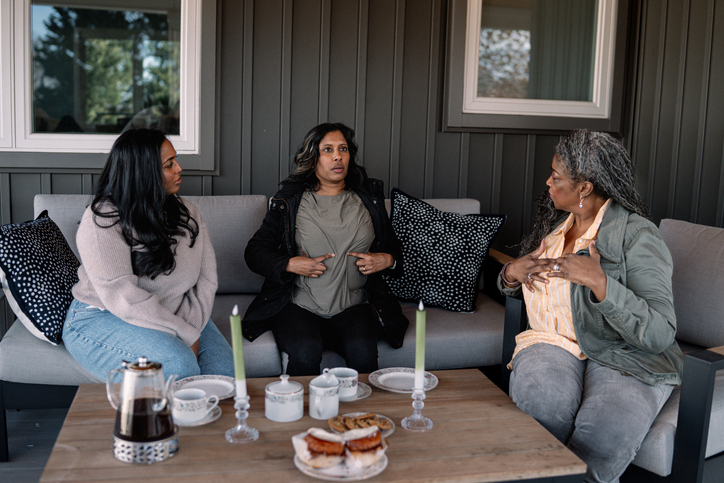

People often say, “It takes a village to raise a child.” But what happens when that child grows up and is diagnosed with a serious illness? Does the village turn away or ignore you? Sometimes, the village steps up to do whatever it can to soften the blow of your illness.
Even though you are no longer a child, if you’ve been diagnosed with breast cancer, you need your community’s support more than ever. When I was diagnosed with Invasive Ductal Carcinoma & Ductal Carcinoma In Situ, I honestly didn’t know what to do, where to turn or even how to see life.
My community is made up of the people who watched me grow–the people I built relationships with who helped me get through it. While currently on my cancer journey, my community is made up of the ladies who have already experienced what I’m going through, and of course, my family, both biological and spiritual.
In October of 2025, I was privileged to be the Keynote Speaker at I Am Not My Diagnoses, a conference hosted by Strengthen the Bond., LLC, which not only celebrated women going through breast cancer, but cancer, period. During that conference, I met strangers who became friends and friends who became sisters, because we were all trying to survive.
What does a support system do?
They do everything you can’t. Listen–cancers of all types, but specifically breast cancers, have a way of making your body feel worse while getting better, so there are days you don’t have the energy to do anything but lie there.
When you can’t clean, they do.
When you can’t cook ( if you have an appetite), they do.
When you can’t pray for yourself…they do.
When you can’t, they simply do.
My mistake was trying to be a superwoman, thinking I could do it all. On day one of treatment, I returned home feeling somewhat decent; the side effects of chemo had not completely kicked in. My neighbor asked if I needed anything, and I humbly declined. Somehow, I thought it was a smart idea to move my living room furniture. I know–what was I thinking, right?
The next moment, I was calling for help and telling my family to pray for me because I had messed up. I suggest you allow whoever wants to support you to do so. Let me remind you that you don’t have to go through this alone, and I’ll keep reminding you of that. When I look back on it, my support system assembled itself.
An unpopular opinion is that your medical professionals only want your money–well, not most of them. Most sincerely want you to get well. After my lumpectomy, I had major complications, and my surgeons, their nurses and even the practitioners called, emailed and checked in through the medical portal. Some might think that their checking on me was only reactionary to the complication, but no. In a very vulnerable moment, we shared personal stories of their journeys, we shared tears and shared hope. So again, allow your medical professionals to support you as well, because you never know–you might be on the same journey and can support each other.
So, what does your support system do? Whatever needs to be done.
Who is your support system?
Even if you don’t have close family, friends and relations out there, there is still a group of people waiting to support you.
The first thing I did was go to websites that were specific to my cancer. I had to learn what was happening to my body, inside and out. Those websites offered so much. If you haven’t found what you are looking for, keep looking.
Learn more about helpful links and resources for patients with breast cancer
Social Media
It can be a beautiful space. Since we’re on it 99 hours of the day anyway, we might as well use it to our advantage. There are millions of groups, private and public, to join. Personally, I have actively joined a private group. The resources, conversations and virtual support can be impactful for everyone involved. Reading the threads for the questions I had provided me with support and strength, and it can do the same for you. I watched videos of those who documented their journeys to give others insight. For me, it was so helpful, and I guarantee it will be the same for you.
In-person support groups
Some people may feel more supported with an in-person experience If you know this about yourself, that’s great! It exemplifies that you know what you need and you are willing to search for it.
Financial
If you are not aware, cancer is expensive! There are resources to assist with financial hardships, whether they are a friend, a foundation or even a stranger who may have heard your story and wants to help. Hey, if they want to pass you a few dollars, let them. Every little bit helps.
Sometimes, support comes from the most unexpected people and places. Remember, you are worth receiving all the support you can handle.
When the supported becomes the supporter
Congratulations! Even if it is premature, you WILL find your support system.
Afterwards, you will be motivated to support and help others in ways that others helped you. Your ability to support others can also come from what you may have been lacking. I want you to see how “helping” is healing. Perhaps, you will grab someone by the hand and support them along the way.
You got this! This diagnosis doesn’t have you and will not defeat you. Keep your hope, faith and determination to beat this. Lastly, I support you!