

I remember the room more than the words.
Across from me sat my husband, hands folded too tightly in his lap, fluorescent lights humming above us in the breast clinic at Markham Stouffville Hospital. When the diagnosis finally came out of the surgeon’s mouth—breast cancer—it didn’t land like a thunderclap. It landed like a dull thud.
There was a numbness–a strange, practical calm.
O.K., I thought. So we’ll do what we have to do.
I found myself watching my husband more than listening to the doctor. I felt almost protective of him, as though I needed to absorb the shock first, to buffer the impact. I was the one with cancer, but in that moment, I was also the one steadying the room.
People talk about devastation. Mine was quieter, administrative. Survival mode clicked on, and feelings politely waited their turn.
A lifetime of scars
In fairness, I am no stranger to scars.
Before the age of four, I had already undergone two open-heart surgeries. My mother used to joke that I looked like a Cabbage Patch doll—stitched at the wrists, ankles, sides where tubes had been and one long line straight down my chest. A tiny roadmap of survival.
As I grew, they faded but never disappeared. I learned to live with them the way you learn to live with freckles or birthmarks—part of the landscape, not the headline.
There were times I considered having them revised or removed. Each time, someone who loved me gently reminded me: they’re part of your story.
So I kept them. Eventually, I even wore them with a quiet kind of pride. Proof that my body had endured and kept going.
After breast cancer, though, I must admit, it has taken time to feel that way again.
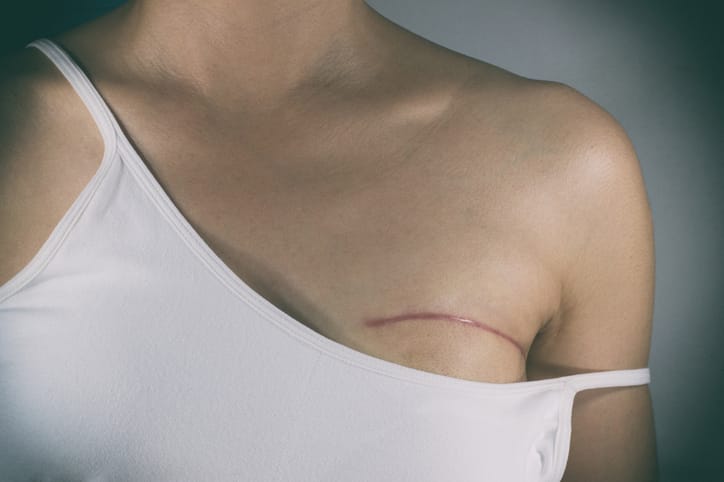
These scars are different. Newer. More visible to me. Tied not to childhood survival but to an adult life interrupted. I know, intellectually, that they tell a story too. My heart is just taking longer to agree.
Saying goodbye to Louise
Before my mastectomy, I did something that still feels both deeply strange and completely necessary.
Not in a quiet pre-op room. Not in private.
I was already in the operating room, perched on that narrow surgical bed under blinding lights, the air cold, the monitors humming, doctors and nurses moving around me with calm efficiency as they prepped me for surgery. It was the most clinical environment imaginable, and somehow, also the most vulnerable I had ever felt.
And right there, out loud, I spoke.
“Goodbye, Louise. It’s been a ride.”
A few heads turned. No one stopped me.
And then, because humour and gratitude were the only things keeping me from dissolving, I kept going.
Thank you for breastfeeding my babies.
Thank you for the cleavage.
Thank you for the way you looked in my dresses — and let’s be honest, you really did look good in those dresses.
Thank you for being part of how I moved through the world as a woman.
Thank you, thank you, thank you.
It sounds absurd when you repeat it afterward, but in that moment it felt sacred. A private ritual performed in the most public, sterile space imaginable. A way of acknowledging that this wasn’t just tissue about to be removed — it was history, identity, motherhood, sexuality, memory.
Gratitude was easier than grief when I still believed I understood what I was losing.
Survival mode has no mirror
After surgery, everything becomes procedural.
Pain meds. Drains. Instructions. Follow-up appointments. How to sleep. How to move. How not to move. You become a project manager of your own body. There is no time—and perhaps no permission—to feel.
For weeks, my chest remained hidden beneath layers of gauze and compression. Out of sight, suspended in a strange in-between state where reality hadn’t fully arrived yet.
As the bandages were peeled back, slowly and carefully, by a nurse in the clinic, I knew I had to finally confront what had happened.
And then I looked.
What came out of me wasn’t a sob or even crying in the usual sense. It was something older. More primitive. A sound pulled from somewhere deep in the body—the kind of cry that bypasses language entirely.
Animal grief. Shock made audible.
I couldn’t contain it. I wasn’t trying to.
In that instant, the illusion of “temporary” disappeared. This wasn’t swelling. This wasn’t something that would settle down and return to normal.
This was amputation–a permanent rewriting of my body.
While I cried, I heard my husband ask the nurse, as she exited the room, whether I had seen them. Later, when I came out—eyes swollen, face raw—there was an understanding between us. No words were needed. He simply took my hand, and we left together.
Mirror, mirror
Mirrors are merciless because they don’t negotiate.
They don’t care about bravery, survival or perspective. They show you what is there, not what used to be there, not what should be there.
For a long time, I avoided them. Quick glances only. Strategic lighting. Clothing as camouflage. It wasn’t vanity; it was identity shock. The person looking back at me felt both intimately familiar and completely foreign.
I had survived, but parts of me had not.
No one tells you that survival comes with mourning. There is no funeral for the body you used to live in. No rituals for saying goodbye to the version of yourself who never had to think about drains, scars, asymmetry or numbness.
Grief without ceremony. Loss without closure.
It wasn’t just appearance.
My energy was different—unreliable, rationed, negotiated. Activities that once required no thought now required planning, pacing, recovery. I mourned the ease of my former body as much as its shape.
Freedom, it turns out, is a physical sensation. You don’t realize how much of life is built on the quiet assumption that your body will simply cooperate.
Louise 2.0
Humour found its way back in, as it tends to do when survival stretches into living again. I eventually named my custom breast form “Louise 2.0.”
Not a replacement. Not an upgrade. More like a collaboration—a prosthetic partnership between the person I was and the person I am becoming.
Louise 2.0 comes off at night. She doesn’t pretend to be original equipment. She also has absolutely no interest in helping with laundry, emotional support or finding matching socks—a disappointing lack of initiative, really.
But she represents adaptation. Resilience. The strange creativity survivorship demands.
People often assume that if you are alive, you should be only grateful. And I am grateful, profoundly so. I am here. I am present for my family. I get more ordinary Tuesdays than I once feared I would.
But gratitude does not cancel grief.
I can be thankful for the body that saved my life and still miss the body I had before. Both things can be true in the same breath, in the same mirror, on the same day.
I once learned to wear my childhood scars proudly because they told a story of survival. I am still learning to do that again.
These newer scars ask different things of me: patience, tenderness, honesty about loss. Some days I meet them with strength. Other days with quiet sadness. Both, I am discovering, are forms of courage.
Over time, the mirror becomes less of an adversary and more of a witness.
I no longer look for the woman I used to be. I look for the one who endured—the one who said goodbye to Louise out loud under surgical lights, who survived surgery, who cried a primal cry behind a closed door, who walked back out to her husband and kept going.
This body is different. It is marked. It is imperfect.
It is also the body that carried me through.
Mirror, mirror on the wall—who is this after all?
Someone who knows, now, that survival has a shape.
And it is hers.
Sign up here to get the latest news, perspectives, and information about breast cancer sent directly to your inbox. Registration is free and only takes a minute.